How Long Does It Take to Learn to Surf? A Santa Monica Surf Instructor Answers
Learning to surf is one of the most exciting things you can do — especially if you're visiting Los Angeles for the first time or finally checking it off your bucket list. But one question comes up more than almost any other when people are researching surf lessons in Santa Monica: how long is this actually going to take? Am I going to be able to stand up on a surfboard?
I'm Lucas Coleman, a professional surf instructor and owner of Calibunga Surf Lessons at Santa Monica Beach. I've been teaching beginner surf lessons near the Santa Monica Pier for over a decade. Today I'm answering a question sent in by Amanda from Phoenix, Arizona, and it's one of the best questions I get.
Amanda asks: "How long does it actually take to learn to surf? If I take a surf lesson in Santa Monica, will I be able to stand up on the board my first try?"
First try? I've seen that maybe two or three times in my entire career. Probably not your first try. But your first day? Let's talk about that.
What Are the Fundamentals Taught in a Beginner Surf Lesson at Santa Monica Beach?
The first thing to understand is that surfing happens in stages. When someone takes their first surf lesson at Santa Monica Beach, the goal isn't to become an expert surfer by the end of the session. The goal is to understand and experience the fundamentals. Those fundamentals are paddling technique, board positioning, wave timing, wave shape, and the pop-up.
If you're not familiar with the term, the pop-up is surf slang for the motion of getting from lying on your board to standing on your feet while riding a wave. In America it's pretty well understood, but for international visitors and tourists it sometimes needs a little explanation. Pop-up means stand-up. That's the move we're working toward.
What Is the Pop-Up and Why Do Surf Instructors Teach It on the Sand First?
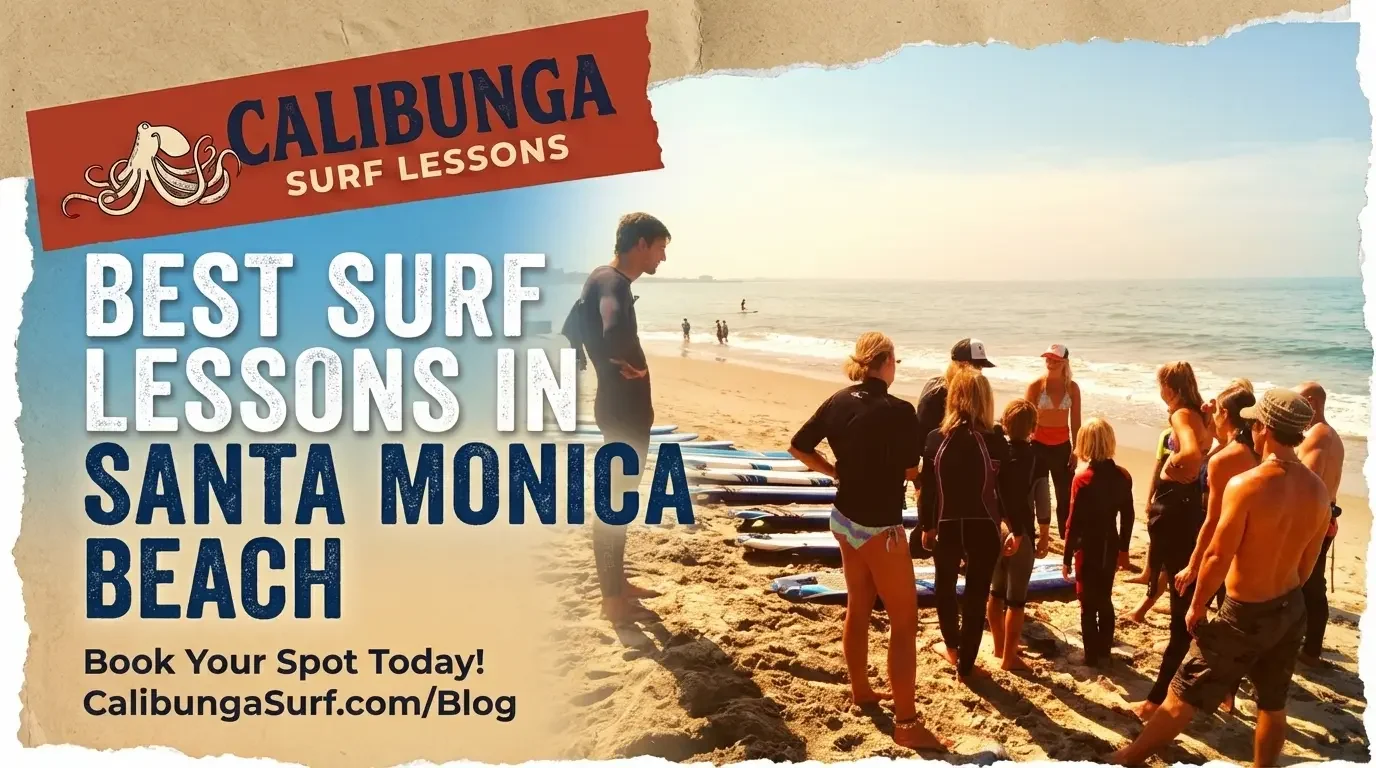
Before we ever get in the ocean, I lay the board down on the sand. We talk about board shape. We look at the water together and observe what the waves are doing that day — because conditions change, and understanding what you're looking at before you paddle out makes a real difference.
Practicing the pop-up on the sand allows beginners to build muscle memory before attempting it on a moving wave. This is critical. If the movement isn't becoming instinctive on flat, stable ground, it's going to be even harder to execute while balancing on a foam board on a wave.
Here's an analogy I use a lot: think about learning to ride a bike. If you sit on a bicycle that isn't moving, you fall over. The moment you're in motion, centrifugal force kicks in and keeps you upright — to the point where you can almost go no hands. The faster you go, the more stable you feel. Surfing works on a similar principle. The wave provides the momentum, and that momentum actually helps keep you upright. Your job is not to fight it. Your job is to flow with it.
This is one of the biggest mindset shifts for new surfers. Most beginners assume surfing requires a huge amount of physical strength and force. It's actually the opposite. Almost all unnecessary tension in surfing is bad. The wave is doing the heavy lifting. Relax, execute the technique, and let it carry you.
What Happens During Your First Surf Lesson Near the Santa Monica Pier?
Once we've covered the fundamentals on the sand and the pop-up movement is starting to click, we head into the water. As a surf instructor, I don't just hand beginners a board and wish them luck. I'm in the water with you the entire time — swimming alongside you, holding the board, keeping you stable, and guiding you into waves. It is completely hands-on from start to finish.
We start with whitewater waves. When a wave breaks and crashes and turns into that churning white foam rolling toward the beach — that's whitewater. It's a wave that has already broken, and it's ideal for beginners because it provides consistent forward momentum without requiring advanced wave-reading skills or precise positioning. You don't have to catch it perfectly. You just have to be ready when it arrives.
Can You Stand Up on a Surfboard Your First Day Taking Surf Lessons in Los Angeles?
Yes — and this is the part people are always surprised to hear. Most students taking beginner surf lessons in Santa Monica are able to get to their feet during their very first session when working with a coach in the whitewater. That doesn't mean they've mastered surfing. But it does mean they've experienced the real, genuine feeling of catching a wave and riding it toward shore on their own two feet. That is surfing.
For context, the ultimate goal of surfing is to catch a wave before it breaks — when it's still smooth and glassy, building toward you. That open, unbroken part of the wave is called the face or the glass. Getting there, reading waves, positioning correctly, and eventually turning and maneuvering down the line — that's the longer journey. But standing up in the whitewater on day one? That's completely within reach for most people.
What Does Surf Progression Look Like After Your First Lesson?
This is where surfing gets really interesting. A lot of people show up thinking they just want to catch one wave, check it off the list, and go home happy. And then they catch that wave — and everything changes. The roof flies off. Suddenly, you're thinking: I could get lower, I could position my feet differently, I could catch the wave earlier, I could look down the coast and start to turn.
Getting to your feet and riding a wave to shore is surfing — but it is the absolute appetizer. The full meal is enormous.
After your first lesson, progression typically unfolds over multiple sessions. You move from whitewater to the open face of the wave. You learn to read swells, choose your position in the lineup, and start generating speed. Then come the turns. Then come smaller boards, bigger waves, and eventually a whole new technical vocabulary — longboarding, shortboarding, hybrid shapes, reef breaks, point breaks, barreling waves. There are surfers who have been in the water for 40 years and are still learning. That is not an exaggeration. It is genuinely one of the deepest sports on the planet, and you cannot fully appreciate that depth until you've experienced it firsthand.
How Long Does a Beginner Surf Lesson Take at Calibunga Surf Lessons in Santa Monica?
My standard beginner surf lessons are 90 minutes, with the option to add an additional 30 minutes. I don't recommend going much longer than that for total beginners — not because there isn't more to learn, but because the ocean is physically demanding and fatigue sets in fast, especially during an intensive first session.
In terms of what you can expect within that time: most students get to their feet and feel like they've genuinely surfed after about an hour. That includes the sand lesson and approximately 20 minutes of solid, repeated wave-riding in the water. Some people get there faster. Some take a little longer. Every person is different, and that's completely fine.
I've had dads pull me aside before a family lesson and quietly tell me they're just there for the memory — they don't expect to actually catch a wave. Then they get up on their first ride and completely forget what they said. That moment, when someone with zero expectations suddenly realizes they're surfing — that never gets old.
Does Calibunga Surf Lessons Teach People of All Fitness Levels and Abilities?
Absolutely. Calibunga Surf Lessons teaches surfers of all fitness levels, ages, and abilities. Students who are out of shape, older adults who want to take it at a slower pace, and individuals with physical disabilities have all learned to surf with us. The approach is always the same: find the right board for that person, understand what they're capable of, and build from there. Progress may look different from one student to the next, but it is always achievable.
The key is that we don't have a one-size-fits-all lesson. We have a one-size-fits-you lesson.
What Makes Calibunga Surf Lessons Different From Other Surf Schools in Los Angeles?
There are a lot of surf schools operating in Los Angeles, and not all of them are teaching the same way. At a lot of tourist-heavy operations — and you see this even more in places like Indonesia or Fiji — the instructors aren't really coaching. They're moving people through a line. They hand you a giant board, shove you into a tiny wave, and you have a fun experience, but you don't actually learn anything. You don't understand what worked, or why, or how to replicate it.
That's not what we do at Calibunga Surf Lessons. Every session starts with a conversation. What are your goals? What's your experience level? Are you here for a one-time experience or are you trying to actually develop as a surfer? The answer to those questions shapes the entire lesson. Whether you're a visitor from out of state who wants a great memory, or a local who wants to genuinely learn the sport — I'm going to coach you accordingly. Technically, personally, and with real attention to what you specifically need to progress.
Should You Take a Surf Lesson in Santa Monica If You're Visiting Los Angeles from Out of State?
One hundred percent yes. Santa Monica Beach is one of the most accessible and beginner-friendly surf spots in the entire country, and taking a lesson near the Santa Monica Pier is a genuinely unique Los Angeles experience. I teach visitors from all over — Ohio, Tennessee, Michigan, Arizona, and well beyond. Some just want a fun activity for a day. Others discover something they didn't know they were looking for.
I've had families come through with full itineraries planned — surf lesson on Saturday, Disneyland on Sunday, Universal Studios on Monday. They surf, they love it, and by Sunday morning they've collectively decided to skip the theme parks and book another day in the water instead. It happens more than you'd think. And for what it's worth, a surf lesson is significantly cheaper than a day at Disneyland.
How Do You Book a Surf Lesson with Calibunga Surf Lessons at Santa Monica Beach?
Amanda, I hope this answers your question. The honest truth is there's no way to know exactly how quickly you personally will learn to surf until you get out there and try. But the odds are good — and the experience is worth it either way.If you have questions about beginner surf lessons in Los Angeles, surfing at Santa Monica Beach, or anything else covered on this podcast, send them in. We answer listener questions live on the show.To book a surf lesson with me, Lucas Coleman, at Calibunga Surf Lessons, visit us online at www.calibungasurflessons.com — we have an automated booking system that makes it easy. You can also reach us by email at info@calibungasurflessons.com, find us on Facebook, Instagram, and TikTok, or simply call or text us directly.We'll see you at the beach. Surf's up soon.